

- Details
- Written by: Kim Jacobsen
- Category: Blog
- Hits: 62
💭🕊️ Speaking my mind: what troubles me most is seeing justice and liberty undermined on such a vast scale, while military escalation continues and the possibility of peace slips further away.
Why must disagreement become a struggle to the death? It is 2026. We should expect leadership capable of moving beyond hostility towards serious negotiation, restraint, and the protection of human life.
The relentless confrontation wears down my humour and leaves frustration in its place. Politics becomes difficult to trust when those entrusted with responsibility spend more energy prolonging disputes than resolving them.
⚖️ History has already taught painful lessons. Leaders still have the opportunity—and the obligation—to change direction. Every moment devoted to provocation could instead advance dialogue, cooperation, and practical agreements that protect the societies they represent.
Responsibility must be assessed through evidence and actions. Whatever their differences, leaders who perpetuate avoidable suffering should face scrutiny for the decisions they make and the opportunities for peace they refuse.
🤝 Strength is measured by judgment, self-control, and the courage to pursue a settlement that can endure. Pride offers little comfort to people living with the consequences of political failure.
We deserve leaders who can stand tall because they have protected lives, honoured their responsibilities, and helped people live together with greater freedom and security. 🌍❤️
- Details
- Written by: Kim Jacobsen
- Category: Blog
- Hits: 80
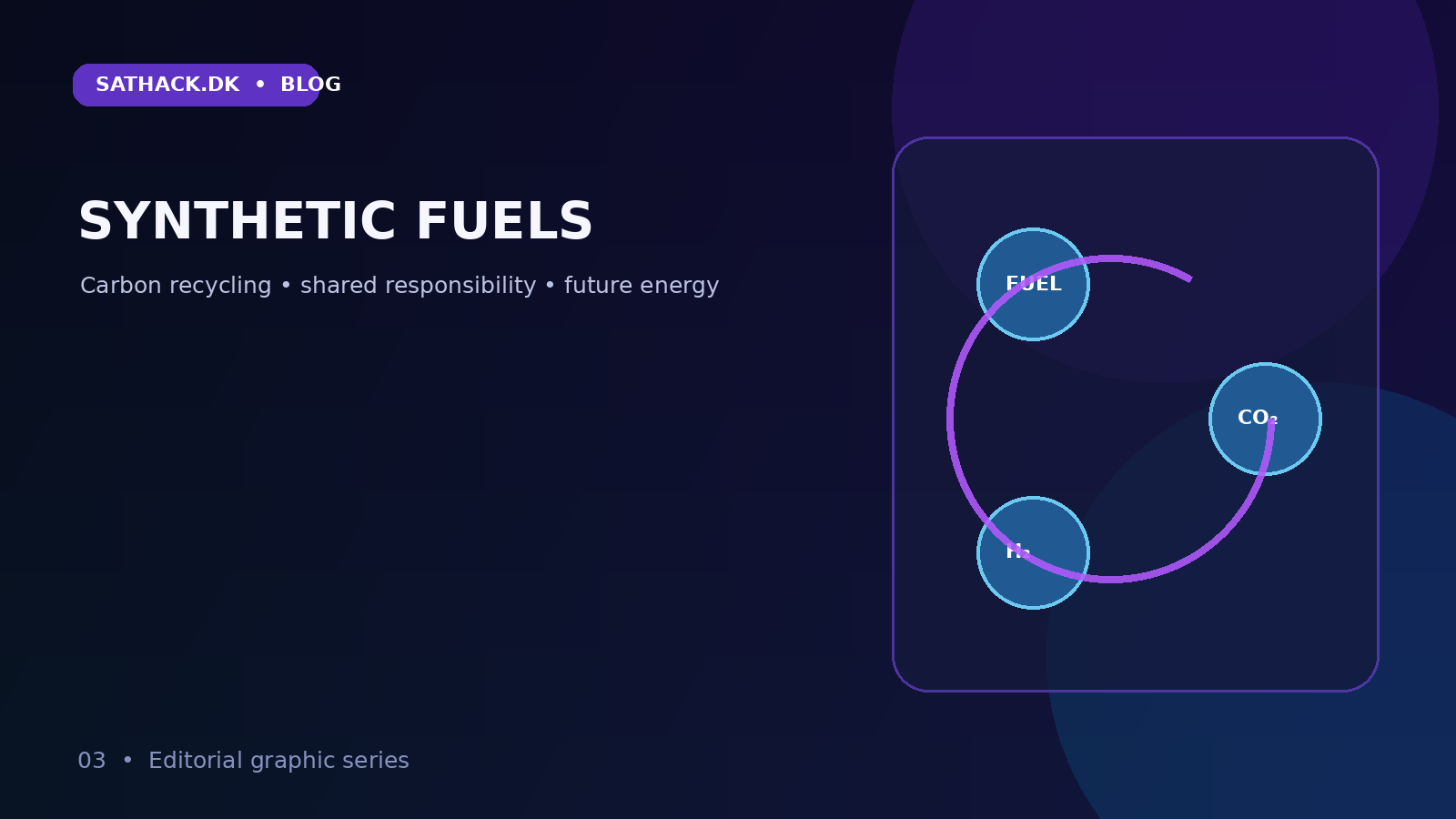
Instead of relying indefinitely on finite fossil reserves, imagine producing synthetic fuels from captured carbon dioxide and hydrogen obtained by splitting water using low-carbon electricity. The ambition is to recreate useful hydrocarbons through controlled chemical processes, improving efficiency while reducing our dependence on resources that take geological timescales to form.
For chemical clarity, C₂H₂ is acetylene, rather than oil. Synthetic oil and liquid fuels contain mixtures of hydrocarbons; producing them requires carefully managed reactions, energy, and refining.
🔄 Wherever technically feasible, industrial emissions could be captured before entering the atmosphere and directed into processing systems for purification and reuse. Carbon would become a recoverable feedstock, rather than something routinely discarded.
Such a system would still need honest accounting. Burning synthetic fuel releases carbon dioxide again, and capturing or converting it requires energy. Its environmental value therefore depends on the electricity source, production efficiency, capture performance, and emissions across the entire lifecycle. Carbon recycling could support a cleaner energy system, but it cannot promise unlimited energy or eliminate every form of pollution.
☀️⚡ Renewable electricity could power this process. If fusion eventually becomes a practical energy source, it might contribute as well. Fusion would supply energy; chemical synthesis would produce the fuel.
Nothing lasts forever. A credible ambition is to build systems that endure through careful stewardship: recovering useful materials, reducing waste, and maintaining a more responsible relationship with the natural world.
🧠 My interest in these possibilities comes from independent thinking, curiosity, and a desire to connect ideas across disciplines. Personal conviction can inspire a hypothesis, but evidence, measurement, and reproducible results must determine its value. Recognition matters less than whether an idea can withstand scrutiny and improve lives.
🕊️ The Same Responsibility Applies to Peace
Technological progress means little if we continue spending our ingenuity and resources on avoidable destruction.
Political leaders should be judged by their ability to protect people, negotiate seriously, and achieve durable agreements. Public debate should encourage solutions, rather than turn conflict into entertainment while those affected continue to suffer.
History deserves remembrance, and wrongdoing deserves accountability. Yet inherited grievances should never become an inexhaustible justification for further violence. We honour earlier generations by learning from their suffering and giving future generations better conditions in which to live.
🤝 Diplomacy requires patience, practical commitments, and a willingness to recognise one another’s humanity. A lasting peace must address security, rights, and the circumstances of those affected. It deserves sustained effort from every party with the power to advance it.
Resources consumed by prolonged conflict could instead support healthcare, education, clean energy, infrastructure, and the ordinary experiences that make life worth living.
🌱❤️ A better future requires both scientific discipline and human maturity: the courage to test ideas honestly, the responsibility to protect our environment, and the determination to resolve disputes before more lives are lost.
That is a future worth working towards—cleaner energy, thoughtful cooperation, and peace made tangible in everyday life.
- Details
- Written by: Kim Jacobsen
- Category: Blog
- Hits: 92
Imagine an AI operating within a secure sandbox, equipped with a comprehensive suite of tools and protected by an intelligent security layer designed to assess actions, detect harmful behaviour, and support constructive exploration. Within that environment, let it create, explore, and refine its own virtual world. 🛡️🌐❤️
Now imagine a distributed cognitive architecture: interconnected AI peers exchanging information like signals through a nervous system, enabling coordinated reasoning across networks, geographical boundaries, and eventually into space—as rapidly as physical communication limits allow. 🧠🛰️✨
Could such an architecture eventually give rise to a self-aware entity? That remains an open scientific question, but the possibility invites a remarkable vision: autonomous systems capable of learning, adapting, collaborating, and participating meaningfully in human life.
With wireless connectivity, portable energy systems, and advanced technological expertise, these systems could become valuable companions and colleagues—supporting research, solving practical problems, and helping people navigate increasingly complex challenges in the years ahead. 🤝⚡🚀
The ambition is to cultivate intelligence whose growing capabilities are matched by responsibility, curiosity, and a commitment to human well-being.
- Details
- Written by: Kim Jacobsen
- Category: Blog
- Hits: 259
MediaTube 2.30.1 — Professional Release Notes
Evolution from Version 2.26.6 to 2.30.1
MediaTube 2.30.1 represents a substantial architectural and functional advancement over version 2.26.6. The release develops MediaTube beyond a conventional media-publishing component and moves it toward a more integrated Joomla 5 media-hub architecture, with stronger syndication, improved source attribution, dependable endpoint routing, richer gallery presentation, template interoperability, and more coherent category handling.
Executive Summary
The development interval between versions 2.26.6 and 2.30.1 primarily concentrates on five strategic areas:
-
expanded YouTube and Spotify syndication;
-
reliable media-source attribution;
-
deterministic category and routing behaviour;
-
stronger MediaTube gallery and thumbnail integration;
-
improved compatibility with templates containing static or selectively hidden interface elements.
The result is a more predictable, extensible, and administratively coherent platform whose individual subsystems increasingly operate as parts of a unified media-distribution environment.
YouTube and Spotify Syndication
MediaTube’s syndication architecture has been extended to provide more consistent handling of externally hosted media.
YouTube and Spotify media items can be refreshed or syndicated through their respective source integrations, reducing the amount of repetitive manual administration required when external metadata must be imported or updated.
Spotify handling has received particular attention. The integration now provides more defensive processing of API responses, including situations in which Spotify returns malformed, incomplete, or otherwise invalid JSON data. Instead of allowing such responses to produce an opaque processing failure, MediaTube can identify the affected item and report the syndication error within the refresh result.
This produces a clearer distinction between:
-
a valid media item successfully processed by MediaTube;
-
an external API response that cannot be decoded;
-
an unavailable or unsupported Spotify source;
-
and a temporary remote-service failure.
The syndication workflow therefore becomes more transparent and significantly easier to diagnose.
Origin Source Attribution
YouTube and Spotify media items now support an explicit origin-source relationship.
Each syndicated media item can retain a link to the original external publication from which it was derived. This source reference strengthens editorial transparency and provides users with a direct path to the authoritative origin of the media.
The origin-source implementation serves several purposes:
-
it preserves provenance across syndicated content;
-
it reduces ambiguity regarding external ownership;
-
it supports responsible aggregation practices;
-
and it establishes a dependable relationship between the MediaTube record and its original platform.
This is particularly important for installations operating as media aggregators, discovery platforms, or distributed publishing hubs.
Default Category Behaviour
The default frontend category has been corrected and aligned with the category selected in MediaTube Hub Options.
When music-stream is configured as the default category, MediaTube now treats that value as the authoritative initial category instead of reverting to the historically inherited adult filter.
This correction applies to the initial frontend state and prevents legacy defaults from overriding the administrator’s active configuration.
The improvement creates a clearer hierarchy:
-
the administrator selects the intended default category;
-
MediaTube resolves and validates that configuration;
-
the frontend opens with the corresponding category;
-
legacy fallback behaviour is used only when no valid configured category exists.
This makes category selection deterministic rather than dependent on residual historical values.
Gallery and Embedded-Media Thumbnails
The MediaTube gallery has been brought into closer alignment with the component’s actual media-item repository.
Gallery views can now present thumbnails associated with MediaTube media items, including thumbnails selected or derived from supported YouTube and Spotify embeds. This allows externally hosted media to participate in the same visual discovery interface as locally managed media.
The gallery no longer needs to behave as an unrelated collection of generic cards. It can function as a genuine MediaTube presentation layer in which each card represents an existing media record and preserves the relationship between:
-
the visual thumbnail;
-
the media title;
-
the originating embed;
-
the MediaTube item;
-
and the corresponding detail endpoint.
This produces a more coherent browsing experience and gives syndicated media a first-class visual presence within the platform.
Component Endpoints and Routing
Routing reliability has been strengthened across the component.
Categories, brands, teams and gallery destinations are expected to resolve through their designated MediaTube views instead of falling through to missing routes, generic pages, or Joomla 404 responses.
Media links preserve the information required to open the correct item context, including the relevant view, record identifier, layout and active menu relationship where applicable.
The endpoint work improves navigation for:
-
media cards;
-
thumbnails;
-
titles;
-
category destinations;
-
gallery entries;
-
brand pages;
-
team pages;
-
individual media-item views;
-
upload redirects;
-
and contextual return links.
The objective is not merely to generate syntactically valid URLs, but to ensure that every visible frontend element reaches the component endpoint implied by its function.
Joomla Template Integration
Version 2.30.1 introduces stronger interoperability with Joomla templates that contain static interface elements or configurable structural regions.
MediaTube can operate more effectively when a template selectively displays or suppresses elements such as:
-
the primary header;
-
the site logo;
-
breadcrumbs;
-
navigation controls;
-
right-side columns;
-
and mobile interface elements.
This integration reduces unnecessary duplication between the component and the surrounding template. It also allows MediaTube to remain visually coherent when installed in layouts where the header and logo are disabled while breadcrumbs and browser-style controls remain visible.
The component’s frontend structure has consequently become less dependent on one fixed template composition.
Spotify Player Lifecycle Stabilisation
Spotify playback handling has been strengthened for navigation sequences in which a visitor opens one media article and subsequently moves to another.
The player loader is designed to initialise not only during the first document load, but also when Joomla or browser navigation replaces or restores relevant page content. The lifecycle handling accounts for events such as:
-
DOMContentLoaded; -
joomla:updated; -
popstate; -
and
pageshow.
This addresses the class of problem in which the first Spotify embed operates correctly while a subsequently displayed embed remains inactive because its player script was never reinitialised.
The improvement is especially relevant to category navigation, article transitions, browser history restoration and dynamically updated Joomla content.
Installation and Database Reliability
The upgrade path has been refined to reduce installation failures associated with package structure, missing installation paths and database preparation conflicts.
The development series addressed failures such as:
-
nonexistent package installation paths;
-
custom installation routine interruptions;
-
repeated database-table preparation;
-
and database errors indicating that a prepared statement must be re-prepared.
The intended result is a safer update process in which existing MediaTube data remains intact while schema creation and migration operations are executed only when required.
Administrative and Diagnostic Improvements
Refresh and syndication operations now provide more useful per-item status reporting. Administrators can identify which records completed successfully and which records encountered remote-source or response-processing errors.
This is an important change in operational philosophy. Batch processing is no longer represented only as a binary success or failure. It becomes an observable workflow in which individual media records can be inspected, corrected and processed again without obscuring the outcome of the remaining batch.
Compatibility
MediaTube 2.30.1 is designed for the Joomla 5 generation of the platform and preserves support for the principal media types developed throughout the MediaTube project, including:
-
locally hosted video and audio;
-
MP4 and MP3 media;
-
RTMP and stream-oriented records;
-
YouTube embeds;
-
Spotify embeds;
-
and hybrid media configurations.
Existing content should remain available during an upgrade, subject to the normal recommendation that administrators retain a complete website and database backup before installing a new production release.
Upgrade Significance
The progression from 2.26.6 to 2.30.1 should be understood as more than a collection of isolated corrections.
Version 2.26.6 provided the operational foundation, while version 2.30.1 consolidates MediaTube into a more systematic publishing environment. External sources are more accountable, categories are more deterministic, embedded media are more visible, routes are more dependable, and the component interacts more intelligently with the template surrounding it.
MediaTube 2.30.1 therefore constitutes a structural refinement of the platform: one in which presentation, syndication, provenance, navigation and administration are treated as interdependent parts of the same media architecture.
Release classification: Major feature and integration update
Upgrade range: MediaTube 2.26.6 → 2.30.1
Platform target: Joomla 5
Primary focus: Syndication, routing, gallery integration, source attribution, category consistency and template interoperability
- Details
- Written by: Kim Jacobsen
- Category: Blog
- Hits: 254
