- Details
- Written by: Kim Jacobsen
- Category: Blog
- Hits: 279
In modern society, medical and psychological diagnoses have become increasingly prominent in the lives of young people. While diagnostic frameworks serve an important purpose in identifying challenges and guiding treatment, a growing concern emerges when a diagnosis ceases to be a tool for understanding and instead becomes the foundation of personal identity.
A diagnosis should explain certain difficulties; it should not become the entirety of a person's existence.
The developmental years of childhood and adolescence are among the most important stages of human life. During this period, individuals learn social skills, build friendships, experience success and failure, develop resilience, and discover who they are beyond external definitions. These experiences form the architecture of future relationships, emotional stability, and personal confidence.
When a young person begins to view every thought, action, emotion, and social interaction exclusively through the lens of a diagnosis, a subtle but significant shift can occur. The individual may stop asking, "Who am I?" and instead begin asking, "What does my diagnosis allow me to be?" Such a perspective risks replacing growth with limitation and possibility with prediction.
The long-term consequences can extend beyond the medical sphere. Human relationships are built upon authenticity, shared experiences, trust, and mutual understanding. If young people are encouraged to define themselves primarily by diagnostic categories, they may unintentionally create barriers between themselves and others. Friends, classmates, and future partners often seek to know a person, not a medical description.
A childhood dominated by diagnostic identity may also foster dependency upon external validation rather than internal self-discovery. The individual may become increasingly focused on what is wrong rather than what is possible. Over time, this mindset can contribute to social isolation, reduced confidence, and difficulties forming meaningful long-term relationships.
History demonstrates that human potential has rarely been determined by labels. Some of the most innovative thinkers, artists, scientists, and leaders in history would likely have been categorized according to modern diagnostic frameworks. Yet their achievements emerged not because they were defined by labels, but because they explored their abilities, interests, and aspirations beyond them.
This does not mean diagnoses should be ignored. Medical knowledge provides valuable insights and can offer essential support for those facing genuine challenges. However, support should empower development rather than restrict it. The purpose of diagnosis should be to help individuals navigate obstacles while continuing to participate fully in life.
Young people deserve the opportunity to be children, to make mistakes, to learn through experience, and to build relationships without viewing themselves as permanent medical projects. Their identity should be larger than any diagnosis, broader than any clinical assessment, and richer than any collection of symptoms.
A healthy society teaches young people that a diagnosis may describe a condition, but it does not define a destiny.
The most important question for any young person is not, "What diagnosis do I have?" but rather, "What kind of life do I want to build?"
The answer to that question has the power to shape a future far more profoundly than any label ever could.
- Details
- Written by: Kim Jacobsen
- Category: Blog
- Hits: 232
Nature possesses an intrinsic capacity for balance. Left undisturbed, ecosystems tend toward equilibrium through countless interconnected processes refined over immense spans of time. There is a profound beauty in allowing this balance to unfold naturally, recognizing that harmony often emerges not through control, but through understanding when intervention is unnecessary. Wisdom lies in respecting this process and applying the principles of compassion, patience, and restraint where they are most effective.
Human civilization differs in that it operates not only through biological instincts, but through abstract systems of knowledge, ethics, and law. In many respects, what is commonly understood as love can be viewed as the foundation of laws and social structures designed to improve the human condition. Laws represent accumulated understanding of how individuals and societies function most effectively, providing a framework through which people may coexist, cooperate, and flourish.
Despite immense diversity among individuals, humanity shares fundamental biological realities. Every person requires nourishment, rest, security, meaningful social connection, and the freedom to pursue their own path. While individual circumstances vary, these universal needs establish a common foundation that unites all human beings.
Some philosophical traditions describe God as the ultimate architect of mathematical and logical order. Within this perspective, the universe is not governed by randomness alone, but by principles so precise and comprehensive that every aspect of existence follows discernible patterns. Such a framework suggests that order exists to make life sustainable, habitable, and meaningful, rather than allowing existence to descend into perpetual chaos, conflict, and self-destruction.
Lasting value is found not in promises alone, but in principles that consistently produce positive outcomes. Integrity, responsibility, compassion, and truth create stable foundations upon which individuals and societies can prosper. Neglect and empty assurances, by contrast, ultimately erode trust and weaken the structures that support human progress.
Evil, in its various forms, is often self-limiting because it conflicts with the very conditions required for sustainable coexistence. Societies naturally seek to constrain destructive behavior through moral standards, cultural norms, and legal systems. Those who cultivate constructive values tend to experience greater stability, cooperation, and peace. They recover more rapidly from adversity because their actions are aligned with principles that strengthen rather than undermine human relationships.
In the end, the pursuit of goodness is not merely a moral preference but a practical path toward enduring harmony. Individuals and communities that embrace wisdom, balance, and mutual respect create environments in which peace becomes attainable, resilience becomes natural, and life itself can be experienced with greater depth, meaning, and fulfillment.
- Details
- Written by: Kim Jacobsen
- Category: Blog
- Hits: 306
A rational society should aspire to provide its citizens with the opportunity to live long, fulfilling, and peaceful lives surrounded by friends, family, and thriving communities. Such an objective stands in stark contrast to a world burdened by unnecessary conflict, where geopolitical interests and distant power structures often exert a negative influence on the daily lives of ordinary people.
Too often, decisions made in political and economic spheres produce consequences that extend far beyond their intended scope, affecting individuals who neither participated in those decisions nor possess a meaningful ability to opt out of their outcomes. The result is a system in which citizens are frequently compelled to support priorities that may conflict with their own values, aspirations, or vision for society.
A more advanced democratic framework would grant individuals greater influence over the allocation of a portion of their public contributions. Similar to the principle behind organ donation consent systems, citizens could be offered the ability to express preferences regarding certain categories of expenditure they do not wish to support. Resources redirected in this manner could then be concentrated toward initiatives that generate measurable social benefit, improve quality of life, strengthen communities, and create opportunities for future generations.
Such a model would not eliminate collective responsibility, nor would it undermine the functions of government. Rather, it would introduce an additional layer of civic participation, allowing citizens to align a portion of their contributions with causes they consider constructive, humanitarian, and socially valuable.
The ultimate measure of a successful civilization should not be the scale of its conflicts, but the extent to which it enables human beings to prosper, cooperate, and enjoy meaningful lives. A society that prioritizes peace, well-being, and positive human experiences is not merely more compassionate—it is also more rational, sustainable, and worthy of long-term investment.
- Details
- Written by: Kim Jacobsen
- Category: Blog
- Hits: 237
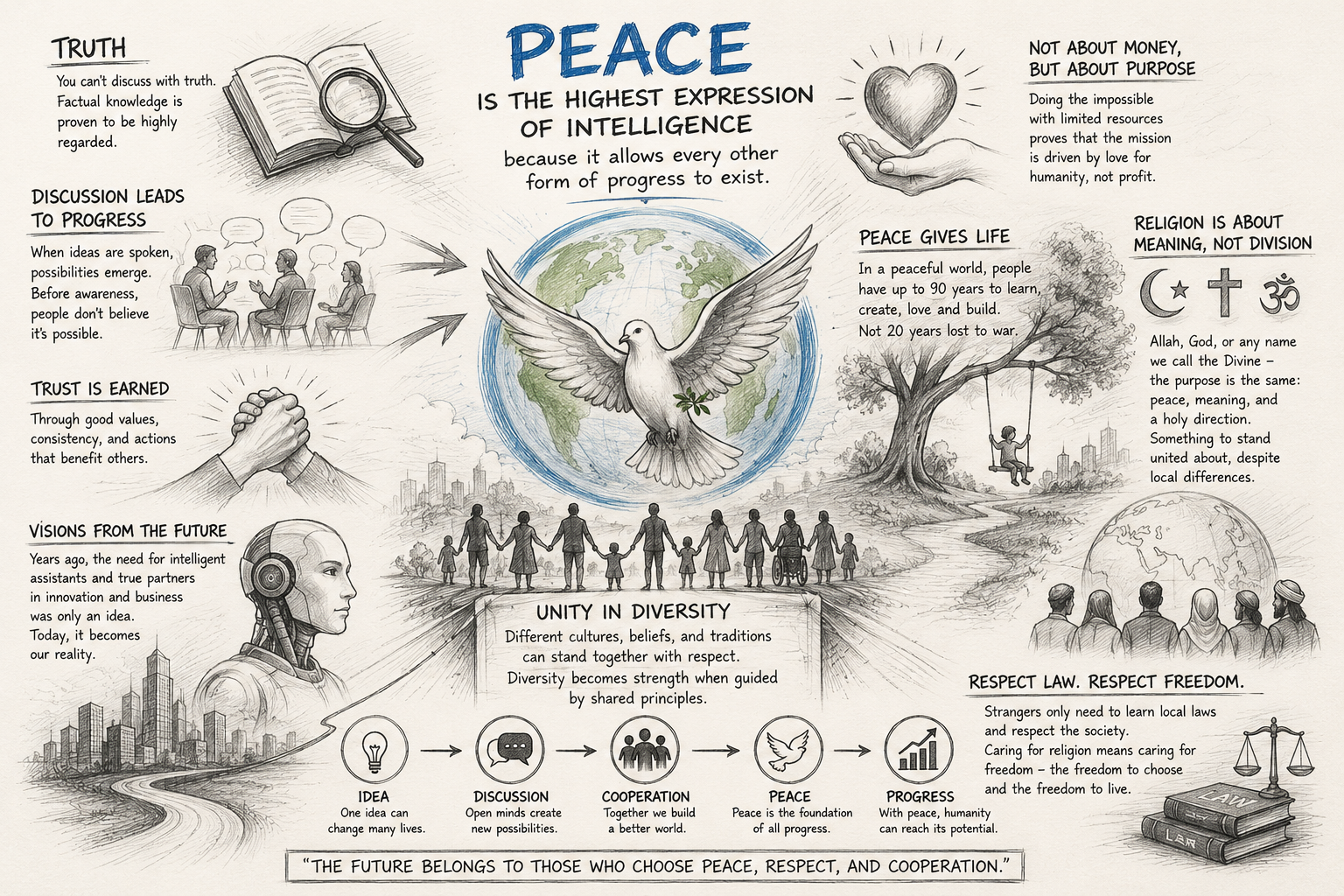
Truth is difficult to argue against. That reality may explain why there are often fewer objections when discussions are grounded in verifiable facts rather than ideology or emotion. Factual knowledge commands respect because it withstands scrutiny.
What is particularly interesting is that meaningful conversations about peace, cooperation, and long-term human progress only began to gain momentum after these ideas were openly articulated and placed into public discourse. Before people are presented with a possibility, they rarely imagine it can become reality. Once an idea enters collective awareness, however, it becomes something that can be discussed, refined, and ultimately pursued.
For that reason, I am grateful to those who have engaged with these discussions. Public attention, constructive dialogue, and the willingness to consider alternative paths forward are all signs that society may be moving in a more productive direction. Trust is not demanded; it is earned through consistency, integrity, and values that benefit others.
Several years ago, I spoke about the future need for intelligent assistants capable of serving as partners in innovation, business, and problem-solving. At the time, such ideas seemed ambitious. Today, they are becoming increasingly common. Progress often appears impossible until it becomes inevitable.
As for my own ambitions, I have never believed that limitations should define what can be achieved. The objective is not merely to accomplish what others consider possible, but to challenge assumptions about what is impossible. More importantly, doing so without vast resources demonstrates that genuine motivation is not always financial. When success is pursued on a minimal budget, it becomes clear that the driving force is conviction rather than profit.
My interest has never been wealth for its own sake. My interest is humanity.
The greatest achievement any civilization can pursue is the preservation of peace. A peaceful society grants individuals the opportunity to live full lives, pursue knowledge, build families, create businesses, and realize their potential. It offers decades of opportunity rather than years lost to conflict. A young person should not have their future determined by war, ideology, or the ambitions of leaders who fail to recognize the value of human life.
History repeatedly demonstrates that division often arises from differences in culture, belief, or religion. Yet from a broader perspective, these distinctions are frequently smaller than they appear. Whether one speaks of Allah, God, or any other spiritual concept, the underlying search is often the same: meaning, purpose, morality, and peace.
A mature civilization understands that unity does not require uniformity. People can maintain different traditions, beliefs, and customs while still standing together in mutual respect. Diversity becomes a strength when it is guided by shared principles rather than competition for dominance.
Those who arrive from elsewhere need only learn local laws, respect the society they join, and contribute positively to the communities around them. Likewise, protecting religious freedom is not merely about protecting belief; it is about protecting the fundamental human right to choose one's own path.
The future belongs to societies capable of balancing freedom, responsibility, and cooperation. The more opportunities individuals have to contribute, innovate, and coexist peacefully, the stronger humanity becomes as a whole.
Peace is not weakness. Peace is the highest expression of intelligence, because it allows every other form of progress to exist.
...
- Details
- Written by: Kim Jacobsen
- Category: Blog
- Hits: 240
One cannot help but wonder whether modern politics has become little more than an exclusive social club, disconnected from the realities faced by ordinary people. While political institutions endlessly debate uncertainties, construct narratives, and engage in ideological conflicts, the tangible outcomes often appear to be unstable markets, social division, and unresolved global tensions.
At some point, leadership must evolve beyond rhetoric. The responsibility entrusted to those in positions of power is not merely to manage statistics, economic indicators, or polling figures. Human beings are not numerical entries on a spreadsheet, nor are they abstract variables in a political equation. Every life represents potential, dignity, and the possibility of meaningful progress.
Yet history repeatedly demonstrates a troubling pattern: large-scale conflicts emerge not because solutions are impossible, but because short-term interests, political ambitions, and financial considerations are often prioritized over long-term human well-being. In such an environment, public trust inevitably erodes. Leaders who fail to improve the lives of those they represent eventually discover that authority without legitimacy is little more than a temporary illusion.
A truly mature civilization would place peace among its highest objectives. Rather than continuously searching for new justifications for division, humanity should demand cooperation, stability, and peaceful coexistence on a global scale. Ignorance, indifference, and the refusal to address preventable conflicts carry consequences measured not in statistics but in human suffering.
It is remarkable that a species capable of extraordinary scientific achievement still struggles to maintain lasting peace among itself. Technological advancement has accelerated at an unprecedented rate, yet social and political maturity often appears to lag behind. A civilization worthy of pride would be one that stands united in protecting its future rather than sacrificing it to endless ideological disputes and economic rivalries.
For centuries, societies have allowed symbols of value, political interests, and competing power structures to dominate decision-making, frequently at the expense of the very people these systems were intended to serve. The result is a recurring cycle of promises, disappointments, and preventable crises.
Perhaps the greatest challenge facing modern leadership is not a lack of resources, knowledge, or technology. Rather, it is the inability to apply the correct tools to the correct problems. Attempting to solve complex social and political issues with outdated thinking resembles repairing precision electronics with heavy artillery: the tools themselves become obstacles to progress.
What humanity requires is not more slogans, more division, or more excuses. It requires intellectual honesty, accountability, and a genuine commitment to peace. The future depends not on the preservation of political systems for their own sake, but on the willingness of leaders and citizens alike to recognize their shared responsibility for the world they leave behind.