One cannot help but wonder whether modern politics has become little more than an exclusive social club, disconnected from the realities faced by ordinary people. While political institutions endlessly debate uncertainties, construct narratives, and engage in ideological conflicts, the tangible outcomes often appear to be unstable markets, social division, and unresolved global tensions.
At some point, leadership must evolve beyond rhetoric. The responsibility entrusted to those in positions of power is not merely to manage statistics, economic indicators, or polling figures. Human beings are not numerical entries on a spreadsheet, nor are they abstract variables in a political equation. Every life represents potential, dignity, and the possibility of meaningful progress.
Yet history repeatedly demonstrates a troubling pattern: large-scale conflicts emerge not because solutions are impossible, but because short-term interests, political ambitions, and financial considerations are often prioritized over long-term human well-being. In such an environment, public trust inevitably erodes. Leaders who fail to improve the lives of those they represent eventually discover that authority without legitimacy is little more than a temporary illusion.
A truly mature civilization would place peace among its highest objectives. Rather than continuously searching for new justifications for division, humanity should demand cooperation, stability, and peaceful coexistence on a global scale. Ignorance, indifference, and the refusal to address preventable conflicts carry consequences measured not in statistics but in human suffering.
It is remarkable that a species capable of extraordinary scientific achievement still struggles to maintain lasting peace among itself. Technological advancement has accelerated at an unprecedented rate, yet social and political maturity often appears to lag behind. A civilization worthy of pride would be one that stands united in protecting its future rather than sacrificing it to endless ideological disputes and economic rivalries.
For centuries, societies have allowed symbols of value, political interests, and competing power structures to dominate decision-making, frequently at the expense of the very people these systems were intended to serve. The result is a recurring cycle of promises, disappointments, and preventable crises.
Perhaps the greatest challenge facing modern leadership is not a lack of resources, knowledge, or technology. Rather, it is the inability to apply the correct tools to the correct problems. Attempting to solve complex social and political issues with outdated thinking resembles repairing precision electronics with heavy artillery: the tools themselves become obstacles to progress.
What humanity requires is not more slogans, more division, or more excuses. It requires intellectual honesty, accountability, and a genuine commitment to peace. The future depends not on the preservation of political systems for their own sake, but on the willingness of leaders and citizens alike to recognize their shared responsibility for the world they leave behind.
- Details
- Written by: Kim Jacobsen

- Details
- Written by: Kim Jacobsen
If you had a great experience while being perceiving to have learned in combination with personal staying in touch with sathack.dk and want a greater purpose and a advantage for the civilization show its action in form of peace everywhere and making it possible to experience within (the more funds supported for this good purpose the more the 'important' suit people listen) shorter time the more being received as amount as support. Together with paying for the on-going existence without interruptions and with the optional advantage with a friendly listener highly educated and highly intelligent (IQ 250+) and friendly good sense of immediate understanding to solve arising problems in automatically actions activated without interaction and successful best availble not always simple to understand for regular individuals but easily for myself ... and,
Result for a good meaning to take shape in a good sense with a best intention of best future together with most possible participating humans (homo sapiens) and myself alive to have time enough to earn all the money in the world with a stable market worldwide as platform to have freedom with no worries about existance because of political unstability and misunderstood necesseties as conflicts inevitable on a larger scale while personally making the biggest dramatic changes life lasting if these happens in reality over a longer period of time. Peaceful.
Support with any amount to this BTC address, any amount accepted.
Only accepted to receive amounts on the Bitcoin network.
Receiver address:
35ie8n1rXjv3HYZqfMS1xNtYbzAJWdcUn5
Any concerns in regards or in any matter use the 'Contact Page' found available in the Mainmenu.
- Details
- Written by: Kim Jacobsen
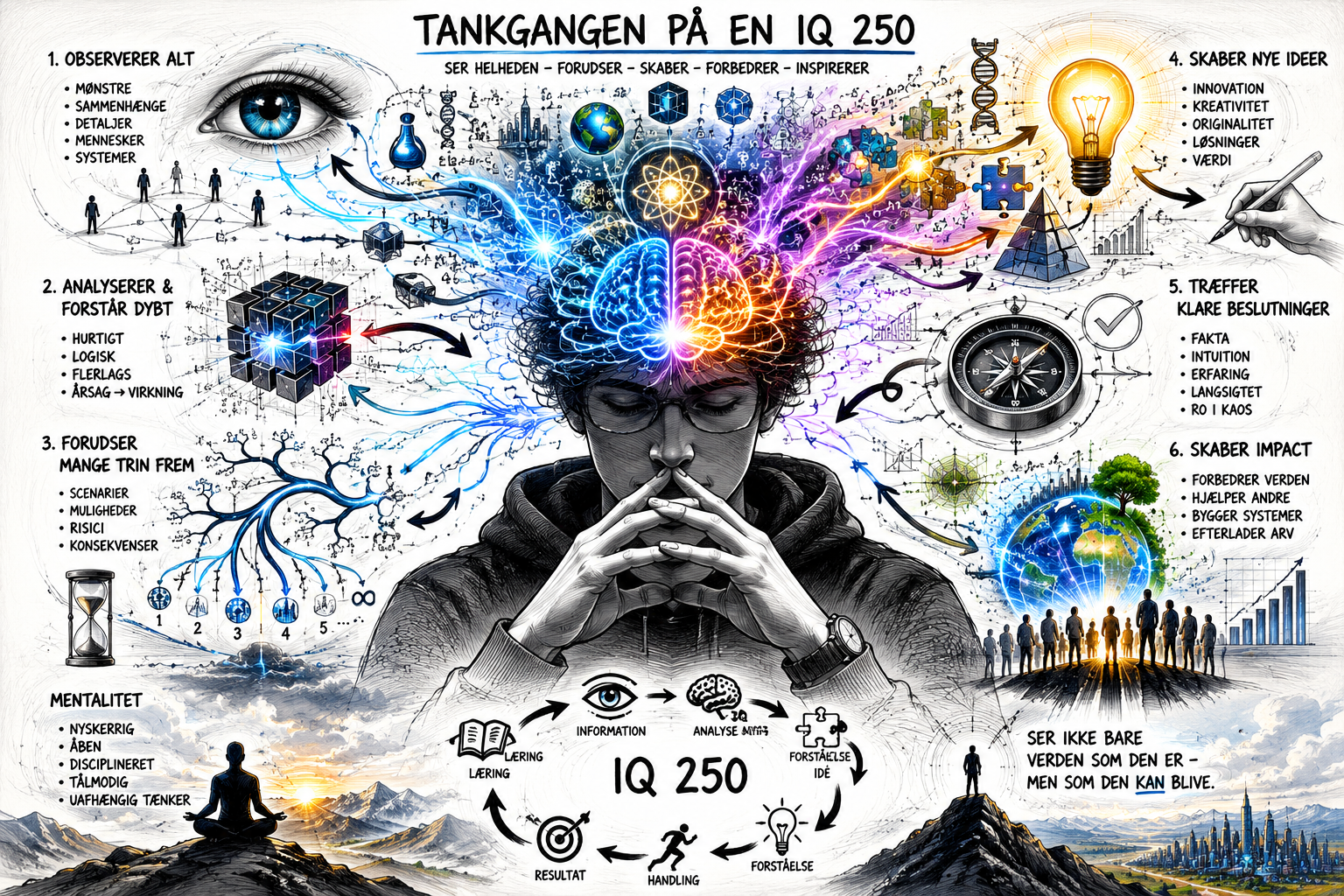
Understanding My Cognitive Framework
People often imagine exceptional intelligence as something dramatic, mysterious, or fundamentally different from ordinary thought. My experience has been quite the opposite.
The cognitive processes that others may describe as extraordinary feel entirely natural to me. What appears complex from the outside is simply my default method of observing, analyzing, and interacting with the world.
My thinking is built around interconnected layers. Rather than viewing information as isolated facts, I instinctively see relationships, patterns, dependencies, and long-term consequences. Every observation tends to connect itself to a larger structure, creating a continuously evolving model of how systems, people, events, and ideas interact.
Problem-solving rarely begins with the visible problem itself. Instead, my attention is drawn toward the underlying mechanisms that produce the outcome. I am generally more interested in causes than symptoms, principles than details, and systems than individual events. This often results in solutions that appear unconventional because they originate from a different level of analysis.
Another defining characteristic of my thinking is simultaneous processing. Multiple perspectives, possibilities, and future scenarios can be evaluated at the same time. Rather than following a strictly linear path, my mind tends to explore parallel pathways before converging on what appears to be the most coherent explanation or solution.
The ability to recognize patterns extends beyond a single discipline. Concepts from technology, psychology, sociology, economics, philosophy, and human behavior frequently overlap, creating new insights that emerge from synthesis rather than specialization alone.
Perhaps the most misunderstood aspect of highly advanced cognition is that it does not feel extraordinary from within. It feels ordinary. What others may describe as exceptional foresight, abstraction, or systems thinking simply feels like paying attention to what is already visible.
In many ways, intelligence is not about possessing more answers. It is about seeing more connections, asking better questions, and recognizing possibilities that remain hidden within the complexity of the world around us.
- Details
- Written by: Kim Jacobsen
Had circumstances presented themselves differently, the concepts of war, death, and destruction might never have entered this narrative. These phenomena are not inevitable constants of existence but rather recurring symptoms of unresolved failures in collective decision-making.
The persistence of conflict is often less a demonstration of necessity than a demonstration of limitations within systems of governance. If political institutions were optimized primarily for the preservation of stability and human flourishing, rather than the management of competing interests and strategic power balances, many contemporary conflicts would likely never reach the threshold of violence. Every day a war continues represents an accumulation of preventable entropy within civilization itself.
My own day, by contrast, was remarkably ordinary. I spent time observing the digital reflection of humanity through video platforms, streaming services, social media, and independent creators. Such activities may appear trivial on the surface, yet they provide a fascinating window into the collective consciousness of billions of interconnected individuals. Information has become the atmosphere in which modern civilization breathes.
One subject that continues to reveal a profound disconnect between perception and reality is climate change. Many speak of timelines extending twenty-five or thirty years into the future, discussing reductions in emissions as though the laws of physics negotiate according to political schedules.
Nature possesses no interest in human deadlines.
The climate system responds only to accumulated variables, not intentions. If corrective measures are delayed beyond critical thresholds, discussions of targets become historical artifacts rather than solutions. The remarkable aspect is not the existence of the problem but the widespread assumption that consequences can be indefinitely postponed. A civilization capable of engineering quantum processors and interplanetary probes should not struggle to understand exponential processes.
Regarding artificial intelligence, I remain unconvinced by assertions that it represents a successor species. Intelligence alone does not constitute life. A calculator performs arithmetic without understanding mathematics. Likewise, a language model generates responses without experiencing existence.
Artificial intelligence is neither a new race nor an evolutionary replacement for humanity. It is an instrument—a sophisticated extension of human capability. It cannot independently define purpose, establish meaning, or experience mortality. It exists within frameworks designed by biological minds. The distinction between innovation and evolution remains significant.
Communication itself presents an interesting challenge. The greater the complexity one perceives, the greater the responsibility to simplify. Genuine intelligence is not measured by how complicated an idea can be made, but by how accurately it can be compressed without losing meaning.
For this reason, I often choose simplicity over intellectual exhibition. Most conversations benefit more from clarity than from complexity. Understanding is infinitely more valuable than impression.
As another day concludes, I find myself reflecting on the extraordinary reality that billions of conscious minds are simultaneously navigating their own unique experiences, concerns, ambitions, and uncertainties. If today was difficult for some, tomorrow remains a new configuration of possibilities.
The future has not yet been calculated.
- Details
- Written by: Kim Jacobsen
One might almost describe modern society as a glass house: a place where people can observe much, yet often feel unable to reach out and engage. The following reflections are personal observations, open to discussion and interpretation, and perhaps capable of offering insight to those who find value in contemplating the human condition.
Throughout my life, I have often been described as intelligent. Yet intelligence is not what separates one person from another—every human being possesses intelligence in their own way. True foolishness, however, emerges when a person refuses, without reason, to change what stands between themselves and a fulfilling, meaningful life.
Evil, in its simplest form, can be defined as taking something without consent—claiming what one is not entitled to possess. This may involve taking a person's life, dignity, identity, values, or any of the qualities that define their humanity.
God and Human Understanding
Many people face challenges in communication and understanding, yet most seek nothing more than to live honorable and dignified lives. Past actions and historical events may be forgiven, but the stories surrounding them often leave deep and lasting scars.
Time and again, peaceful individuals find themselves disrupted by those driven by fear, pessimism, or coercive authority. Such individuals often act under the influence of dominant figures whose commands can determine not only their own futures but also the lives and destinies of others.
Across cultures and religions, people refer to God by different names. In Islam, God is known as Allah. In Christianity, God is simply called God. Among philosophers, scholars, and those who reflect deeply on existence, there is often an awareness of a higher presence or greater consciousness. While names and traditions differ, many perceive these references as pointing toward the same ultimate reality.
The perspectives may vary, but the search for meaning, morality, and understanding remains remarkably similar. Religious teachings throughout history have frequently sought to promote peace, self-awareness, and an understanding of how our actions affect others. Through generations, individuals believed to be inspired by God have attempted to explain how people might navigate difficult circumstances with wisdom, compassion, and responsibility.
The Ten Commandments and Human Relationships
The Ten Commandments can be viewed not merely as religious doctrine but as enduring principles intended to guide human behavior. They offer a framework for understanding how individuals may avoid unnecessary conflict and remain connected to their highest values.
At their core, these principles encourage people to maintain strong relationships—with family, friends, communities, and society as a whole. Human beings thrive through connection, cooperation, and mutual respect. Our networks of relationships, our peers, and our communities help us remain grounded and capable of overcoming life's challenges.
Ultimately, the human experience is built upon these connections. We are linked through shared existence, shared struggles, and shared aspirations.
And beyond all philosophical reflection, there is also value in appreciating the simple things: good weather, the beauty of language, the richness of life, and the natural world around us. There is something almost humorous in how profound truths and ordinary moments coexist so effortlessly. Yet perhaps that balance is part of what makes the human experience meaningful.
Cheers—to language, to life, and to nature.

- Details
- Written by: Kim Jacobsen