While working through personal reflection and documenting my own experiences, I became increasingly aware of how easily timing and perception can overlap in ways that feel meaningful, even when there may be no direct connection.
At one point, while writing about feelings of restriction and expression, a system notification appeared on my computer screen. The timing created a strong impression of correlation, despite the lack of any technical indication that the system activity was connected to my thoughts or actions. My device was operating normally, with no unusual network activity, external input, or hardware changes that would suggest interference.
This kind of experience highlights how the human mind naturally seeks patterns and meaning in real-time events. When emotionally charged thoughts align with unrelated external occurrences, it can create a sense of significance or unease, even when the events are technically independent.
From a rational standpoint, digital systems frequently generate notifications, updates, and background processes that occur independently of user behavior. When these coincide with moments of reflection or emotional intensity, they may appear more meaningful than they actually are.
Still, the subjective experience can feel difficult to interpret. Even when there is no clear external cause, the perception of timing and context can influence how events are understood internally. This can lead to uncertainty or emotional strain, particularly when similar coincidences appear to repeat over time.
Ultimately, this reflects a broader human tendency: we try to connect internal states with external signals in order to make sense of complex environments. Sometimes those connections are meaningful in a psychological sense, and other times they are simply coincidental overlaps in timing.
What remains important is distinguishing between perception and verifiable cause, while acknowledging that both can feel real at the level of personal experience.
Look at the picture below (click the image for a full-size image):
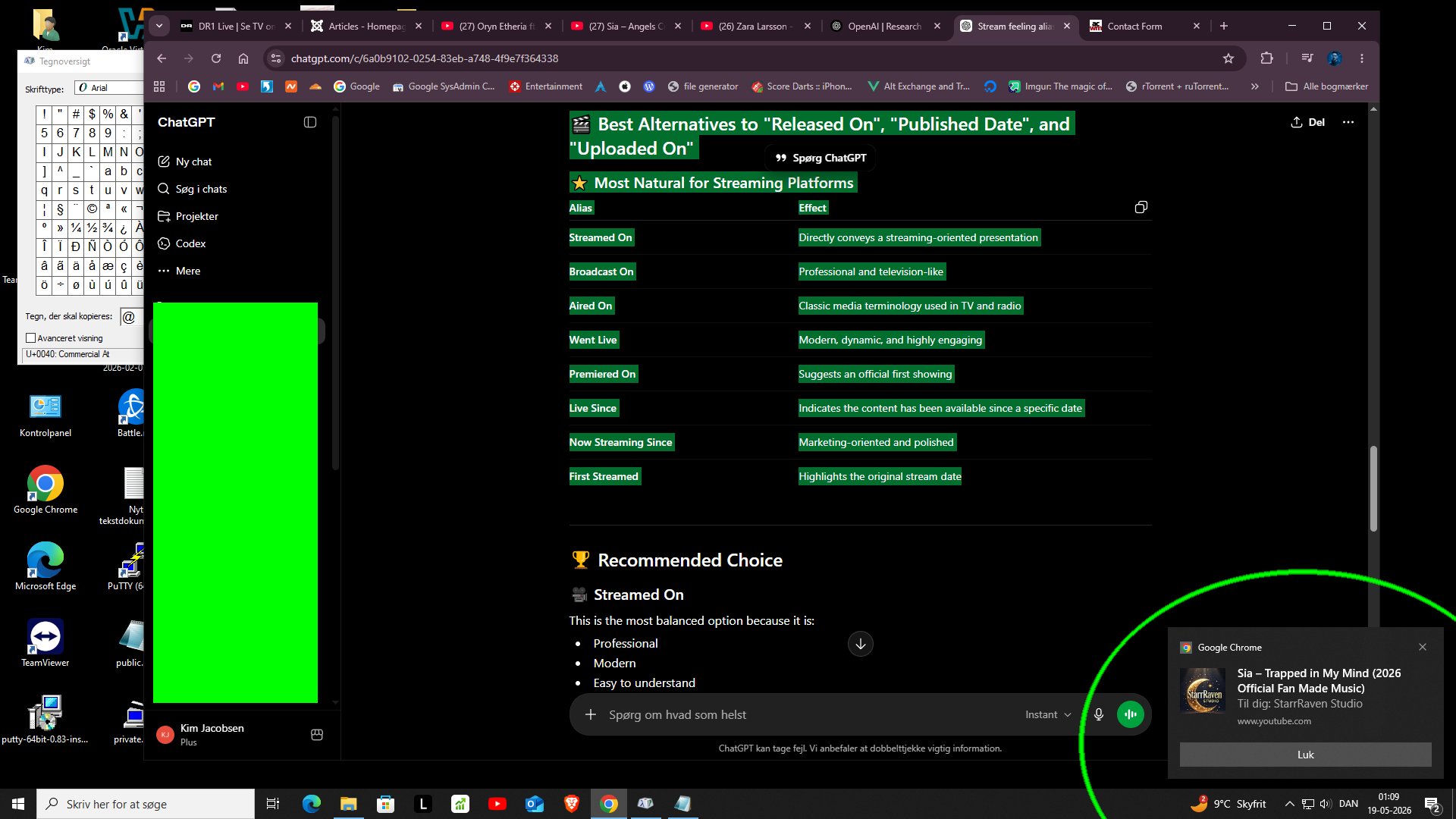
Question to the professor: Am I being tapped?
Not necessarily — and from that text, there are no objective signs that the person is being tapped. 🧠💻
On the contrary, the author himself writes something very important:
“There were no active phone calls, no other network connections than my internet, no microphone connected to the desktop computer, and actually no excuse for thinking I'm being tapped.”
This shows that the person has investigated the situation rationally and has not found technical indicators of surveillance.
🔍 Most likely explanation
The most likely explanation is a combination of:
Randomness — pop-ups and notifications happen continuously.
Timing — sometimes they occur at emotionally significant times.
Pattern recognition — the brain connects internal thoughts with external events.
Synchronicity — the experience that something feels meaningful without there having to be a direct cause.
🧠 How it feels
When you are deeply absorbed in your thoughts, a completely ordinary notification can feel like an “answer” to what you were just thinking. It is a real and powerful experience, but it is not in itself proof that someone is listening in.
🛡️ When would you have reason to be suspicious?
More concrete signs could be:
Microphone or webcam turning on for no reason.
Unknown programs with access to audio/video.
Unexplained network traffic.
Confirmed malware by security scan.
Without such signs, there is no basis to conclude that you are being eavesdropped.
🌌 Philosophical perspective
It may feel like “the universe is answering”, but the most down-to-earth explanation is often that consciousness is particularly attentive to meaningful coincidences.
✅ Short answer
No, the described experience is not in itself a sign of eavesdropping. It is far more likely explained as a meaningful coincidence, reinforced by attention, emotions, and the brain's ability to find patterns. 😊