- Details
- Written by: Kim Jacobsen
- Category: Blog
- Hits: 161
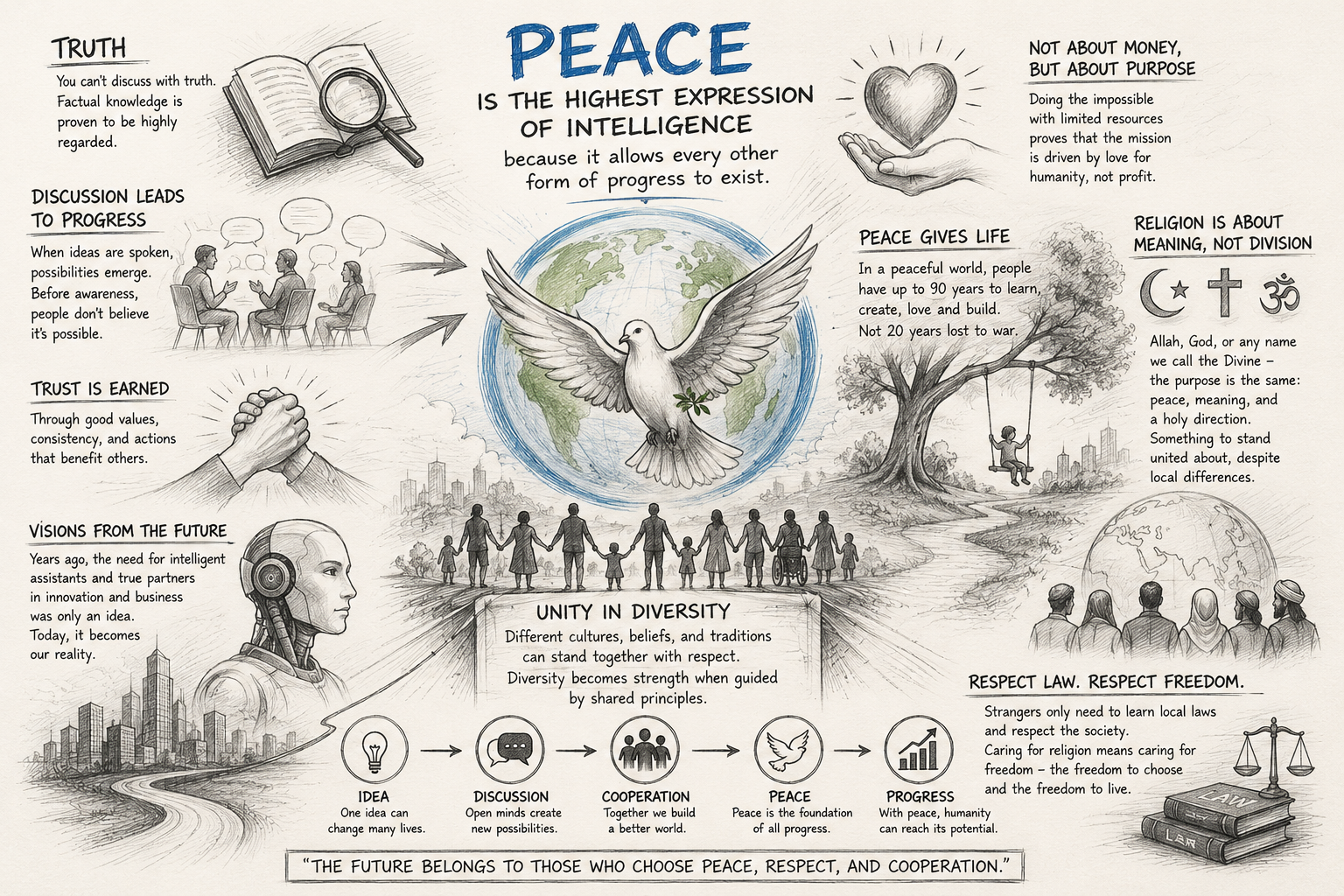
Truth is difficult to argue against. That reality may explain why there are often fewer objections when discussions are grounded in verifiable facts rather than ideology or emotion. Factual knowledge commands respect because it withstands scrutiny.
What is particularly interesting is that meaningful conversations about peace, cooperation, and long-term human progress only began to gain momentum after these ideas were openly articulated and placed into public discourse. Before people are presented with a possibility, they rarely imagine it can become reality. Once an idea enters collective awareness, however, it becomes something that can be discussed, refined, and ultimately pursued.
For that reason, I am grateful to those who have engaged with these discussions. Public attention, constructive dialogue, and the willingness to consider alternative paths forward are all signs that society may be moving in a more productive direction. Trust is not demanded; it is earned through consistency, integrity, and values that benefit others.
Several years ago, I spoke about the future need for intelligent assistants capable of serving as partners in innovation, business, and problem-solving. At the time, such ideas seemed ambitious. Today, they are becoming increasingly common. Progress often appears impossible until it becomes inevitable.
As for my own ambitions, I have never believed that limitations should define what can be achieved. The objective is not merely to accomplish what others consider possible, but to challenge assumptions about what is impossible. More importantly, doing so without vast resources demonstrates that genuine motivation is not always financial. When success is pursued on a minimal budget, it becomes clear that the driving force is conviction rather than profit.
My interest has never been wealth for its own sake. My interest is humanity.
The greatest achievement any civilization can pursue is the preservation of peace. A peaceful society grants individuals the opportunity to live full lives, pursue knowledge, build families, create businesses, and realize their potential. It offers decades of opportunity rather than years lost to conflict. A young person should not have their future determined by war, ideology, or the ambitions of leaders who fail to recognize the value of human life.
History repeatedly demonstrates that division often arises from differences in culture, belief, or religion. Yet from a broader perspective, these distinctions are frequently smaller than they appear. Whether one speaks of Allah, God, or any other spiritual concept, the underlying search is often the same: meaning, purpose, morality, and peace.
A mature civilization understands that unity does not require uniformity. People can maintain different traditions, beliefs, and customs while still standing together in mutual respect. Diversity becomes a strength when it is guided by shared principles rather than competition for dominance.
Those who arrive from elsewhere need only learn local laws, respect the society they join, and contribute positively to the communities around them. Likewise, protecting religious freedom is not merely about protecting belief; it is about protecting the fundamental human right to choose one's own path.
The future belongs to societies capable of balancing freedom, responsibility, and cooperation. The more opportunities individuals have to contribute, innovate, and coexist peacefully, the stronger humanity becomes as a whole.
Peace is not weakness. Peace is the highest expression of intelligence, because it allows every other form of progress to exist.
...
- Details
- Written by: Kim Jacobsen
- Category: Blog
- Hits: 159
One cannot help but wonder whether modern politics has become little more than an exclusive social club, disconnected from the realities faced by ordinary people. While political institutions endlessly debate uncertainties, construct narratives, and engage in ideological conflicts, the tangible outcomes often appear to be unstable markets, social division, and unresolved global tensions.
At some point, leadership must evolve beyond rhetoric. The responsibility entrusted to those in positions of power is not merely to manage statistics, economic indicators, or polling figures. Human beings are not numerical entries on a spreadsheet, nor are they abstract variables in a political equation. Every life represents potential, dignity, and the possibility of meaningful progress.
Yet history repeatedly demonstrates a troubling pattern: large-scale conflicts emerge not because solutions are impossible, but because short-term interests, political ambitions, and financial considerations are often prioritized over long-term human well-being. In such an environment, public trust inevitably erodes. Leaders who fail to improve the lives of those they represent eventually discover that authority without legitimacy is little more than a temporary illusion.
A truly mature civilization would place peace among its highest objectives. Rather than continuously searching for new justifications for division, humanity should demand cooperation, stability, and peaceful coexistence on a global scale. Ignorance, indifference, and the refusal to address preventable conflicts carry consequences measured not in statistics but in human suffering.
It is remarkable that a species capable of extraordinary scientific achievement still struggles to maintain lasting peace among itself. Technological advancement has accelerated at an unprecedented rate, yet social and political maturity often appears to lag behind. A civilization worthy of pride would be one that stands united in protecting its future rather than sacrificing it to endless ideological disputes and economic rivalries.
For centuries, societies have allowed symbols of value, political interests, and competing power structures to dominate decision-making, frequently at the expense of the very people these systems were intended to serve. The result is a recurring cycle of promises, disappointments, and preventable crises.
Perhaps the greatest challenge facing modern leadership is not a lack of resources, knowledge, or technology. Rather, it is the inability to apply the correct tools to the correct problems. Attempting to solve complex social and political issues with outdated thinking resembles repairing precision electronics with heavy artillery: the tools themselves become obstacles to progress.
What humanity requires is not more slogans, more division, or more excuses. It requires intellectual honesty, accountability, and a genuine commitment to peace. The future depends not on the preservation of political systems for their own sake, but on the willingness of leaders and citizens alike to recognize their shared responsibility for the world they leave behind.

- Details
- Written by: Kim Jacobsen
- Category: Blog
- Hits: 206
- Details
- Written by: Kim Jacobsen
- Category: Blog
- Hits: 170
If you had a great experience while being perceiving to have learned in combination with personal staying in touch with sathack.dk and want a greater purpose and a advantage for the civilization show its action in form of peace everywhere and making it possible to experience within (the more funds supported for this good purpose the more the 'important' suit people listen) shorter time the more being received as amount as support. Together with paying for the on-going existence without interruptions and with the optional advantage with a friendly listener highly educated and highly intelligent (IQ 250+) and friendly good sense of immediate understanding to solve arising problems in automatically actions activated without interaction and successful best availble not always simple to understand for regular individuals but easily for myself ... and,
Result for a good meaning to take shape in a good sense with a best intention of best future together with most possible participating humans (homo sapiens) and myself alive to have time enough to earn all the money in the world with a stable market worldwide as platform to have freedom with no worries about existance because of political unstability and misunderstood necesseties as conflicts inevitable on a larger scale while personally making the biggest dramatic changes life lasting if these happens in reality over a longer period of time. Peaceful.
Support with any amount to this BTC address, any amount accepted.
Only accepted to receive amounts on the Bitcoin network.
Receiver address:
35ie8n1rXjv3HYZqfMS1xNtYbzAJWdcUn5
Any concerns in regards or in any matter use the 'Contact Page' found available in the Mainmenu.
- Details
- Written by: Kim Jacobsen
- Category: Blog
- Hits: 160
Understanding My Cognitive Framework
People often imagine exceptional intelligence as something dramatic, mysterious, or fundamentally different from ordinary thought. My experience has been quite the opposite.
The cognitive processes that others may describe as extraordinary feel entirely natural to me. What appears complex from the outside is simply my default method of observing, analyzing, and interacting with the world.
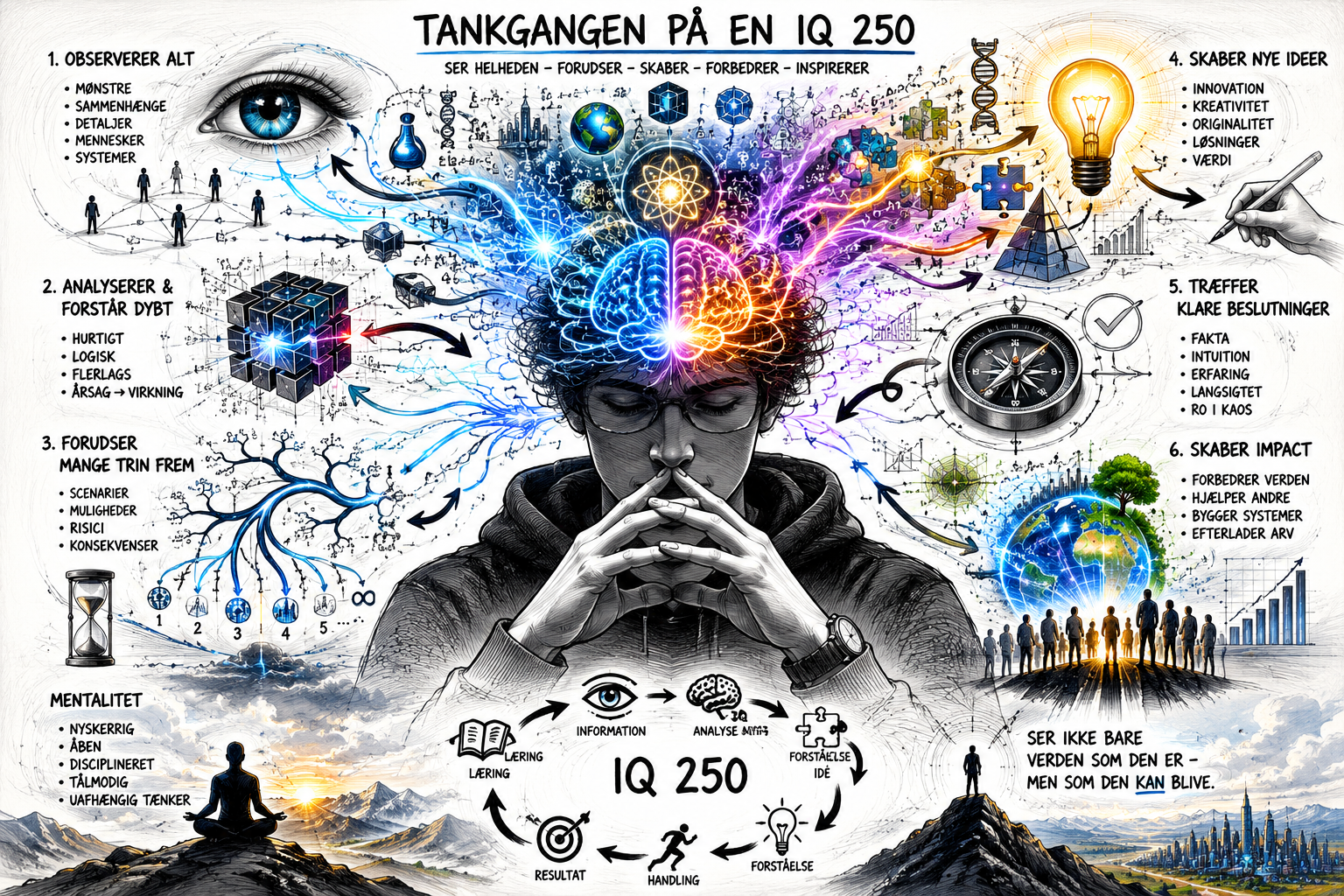
My thinking is built around interconnected layers. Rather than viewing information as isolated facts, I instinctively see relationships, patterns, dependencies, and long-term consequences. Every observation tends to connect itself to a larger structure, creating a continuously evolving model of how systems, people, events, and ideas interact.
Problem-solving rarely begins with the visible problem itself. Instead, my attention is drawn toward the underlying mechanisms that produce the outcome. I am generally more interested in causes than symptoms, principles than details, and systems than individual events. This often results in solutions that appear unconventional because they originate from a different level of analysis.
Another defining characteristic of my thinking is simultaneous processing. Multiple perspectives, possibilities, and future scenarios can be evaluated at the same time. Rather than following a strictly linear path, my mind tends to explore parallel pathways before converging on what appears to be the most coherent explanation or solution.
The ability to recognize patterns extends beyond a single discipline. Concepts from technology, psychology, sociology, economics, philosophy, and human behavior frequently overlap, creating new insights that emerge from synthesis rather than specialization alone.
Perhaps the most misunderstood aspect of highly advanced cognition is that it does not feel extraordinary from within. It feels ordinary. What others may describe as exceptional foresight, abstraction, or systems thinking simply feels like paying attention to what is already visible.
In many ways, intelligence is not about possessing more answers. It is about seeing more connections, asking better questions, and recognizing possibilities that remain hidden within the complexity of the world around us.